Pains In The Butt
The traffic jam with no crash in it
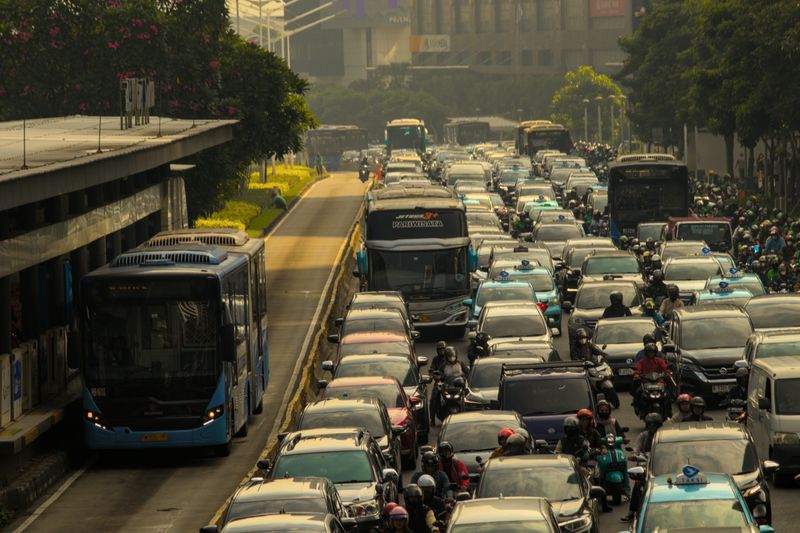
A queue can form on an empty stretch of motorway with no obstruction anywhere. The cause is behind you, several minutes ago.
Treat the sections below as a sequence. With phantom traffic jams, getting the early decisions right makes the later ones much easier.
Before you start
- A single braking event propagates backwards as a wave at a roughly constant speed.
- Traffic near capacity is unstable, so small disturbances amplify rather than fade.
- Maintaining a steady gap absorbs the wave instead of transmitting it.
The jam travels backwards while the cars travel forwards
When traffic is dense, one driver braking forces the driver behind to brake slightly harder, because reaction time means they start later and must lose more speed. That amplification repeats down the line, and a few dozen cars later somebody is stopping completely for a reason that no longer exists. The resulting stop-and-go wave moves backwards along the road at a speed that is remarkably consistent across studies and countries.
Drivers therefore arrive at a jam that is coming toward them, sit in it for a minute, and emerge onto clear road with nothing to blame. The cause was a lane change or a light brake tap several minutes earlier, and by then it is kilometres away in the other direction.
Density is what makes small disturbances grow
Below a certain density, gaps are large enough for a disturbance to be absorbed, and the same brake tap simply fades out behind the car that made it. Above it, the flow becomes unstable, meaning any perturbation grows rather than shrinks, which is a property of the system rather than of any driver. Roads operating near capacity are therefore extremely sensitive, and the difference between free flow and a queue can be a handful of additional vehicles.
Read the terms and there it is: this is why a motorway can go from moving to stopped with no apparent trigger, and why it stays stopped long after the trigger is gone. It also explains why adding a small amount of traffic to a busy road causes a disproportionate loss of speed.
Merging is the reliable trigger
On-ramps inject vehicles that must accelerate to match traffic, and every merge produces at least a small braking event in the main flow. Ramp metering, which releases vehicles onto the motorway at controlled intervals, exists specifically to keep those disturbances small enough to be absorbed. Lane drops and roadworks do the same thing at a fixed location, which is why a queue there is stationary rather than travelling.
The zip merge, where drivers use both lanes fully and merge alternately at the pinch point, is more efficient than merging early despite feeling wrong. Merging early creates a long single queue and leaves half the road empty, which reduces the storage available and lengthens the tailback.
Why smooth driving helps everybody behind you
A driver who leaves a larger gap can respond to the car ahead by lifting off rather than braking, which absorbs the wave instead of passing it on. Simulations and small-scale road experiments have both shown that a modest number of drivers doing this can dissipate a stop-and-go wave. Adaptive cruise control does this automatically when tuned for smoothness, and does the opposite when tuned for short following distances.
The technique costs you nothing in journey time, because you arrive at the same congestion at the same moment either way.
What it changes is the amplitude of the wave for everyone behind you, which is a genuinely unusual case of free collective benefit.
The counterintuitive results
Adding road capacity often fills with additional traffic within a few years, an effect known as induced demand and observed in many road schemes. Removing a road can occasionally improve flow, because network routing does not always improve when an option is added. Speed limits reduced during heavy flow frequently increase throughput, since smoother slower traffic carries more vehicles per hour than fast unstable traffic.
Somewhere in the release notes, that is why variable limits appear on busy motorways and why they feel punitive while measurably helping. Traffic is a flow problem rather than a speed problem, and almost all the confusion comes from conflating the two.
If a charge looks wrong, the boring route — written complaint, then the ombudsman or regulator — still works better than a review.
Practical driving that actually helps
Keep a consistent gap rather than a minimum one, and respond to brake lights two or three cars ahead rather than to the one immediately in front. Avoid closing gaps aggressively in dense traffic, since the gap is the buffer that stops you transmitting the wave. Use both lanes to the merge point at a lane closure, and let one vehicle in at the pinch, which is the design the road intended.
On hold for the fourth time, expect the queue to clear as suddenly as it appeared, because you are driving out of the back of a wave rather than past an obstruction. None of this makes your own journey faster, which is precisely why so few people do it.
The takeaway
Leave the gap. It is the only thing on the road that absorbs a jam instead of passing it on.
The fix is usually trivial, which is the most annoying part.
Questions readers ask
Why does the jam clear with nothing to see?
Because the disturbance that caused it happened minutes earlier and has since travelled backwards past you. There was never anything to see at the front.
Is merging early more polite?
It feels polite and reduces road capacity. Using both lanes to the pinch point and merging alternately moves more vehicles through.
Also by Debashis Panda
- Hold music is not an apology, it is a queue management toolPains In The Butt
- Clamshell packaging: the box that defeats the customer to defeat the thiefPains In The Butt
- The free trial that needs your card is not measuring your interestMoney Suckers
- The update removed the feature you were using it forTech That Sucks