Workplace BS
The open-plan office was sold as collaboration and delivered headphones
Removing the walls was justified by spontaneous interaction. What it reliably produces is people wearing noise-cancelling headphones to simulate a wall.
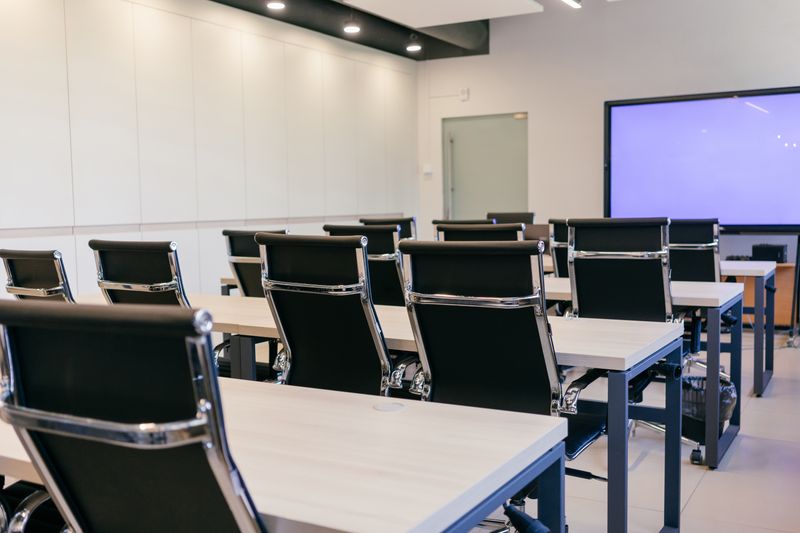
Everything below about open-plan offices comes from what actually happens rather than from what is supposed to.
What holds up in practice
- Studies have generally found face-to-face interaction falls after open-plan conversion.
- Irrelevant speech is the specific noise that damages concentration most.
- Floor space per employee is the reliable and unstated driver.
The stated benefit does not usually appear
Open-plan conversions are justified by increased spontaneous collaboration, which is a testable claim and has been tested more than once. Studies tracking interaction before and after conversion have generally found face-to-face contact falls rather than rises, with messaging volume increasing instead.
The proposed explanation is that visible availability without privacy makes people withdraw, since a conversation in the open has an audience. Headphones function as a socially acceptable closed door, and the widespread adoption of them is the clearest evidence about what people needed. This is a general finding rather than a universal one, and effects vary substantially by role, layout and organisational culture.
Speech is the specific problem
Concentration is damaged far more by intelligible speech than by continuous noise of the same volume, which is a well-established effect in acoustic research. The mechanism is that language is processed involuntarily, so a nearby conversation competes directly with any task involving reading, writing or reasoning. This is why an open office at the same decibel level as a busy road is considerably harder to work in than the road.
Three clicks later, sound masking systems address it by raising the noise floor so speech becomes unintelligible sooner, which works and feels unpleasant. The physical fix is distance, absorption and screens, all of which cost floor space, which is where the whole argument began.
Floor space is the actual driver
Open layouts fit more people into less area, and property is usually among the largest fixed costs an organisation carries. That makes the conversion straightforwardly rational as a cost decision, and it would be far less contentious if it were presented as one. Presenting a cost decision as a productivity benefit invites the workforce to evaluate it as a productivity benefit, which it then fails.
The credibility damage from that framing frequently outlasts the layout, and it is entirely self-inflicted. Organisations that said plainly that they needed to reduce property cost, and then invested in acoustics, generally had an easier time.
Hot-desking added a second problem
Removing assigned desks saves further space by exploiting the fact that not everyone is present at once, which is arithmetically sound. It also removes the small territorial anchor that makes a workplace feel habitable, and the daily cost of finding and setting up a desk. Booking systems attempt to solve the search cost and introduce a new task, along with the phenomenon of desks booked and never used.
The bit they bury in the confirmation email: teams that need to sit together end up coordinating manually, which recreates assigned seating through an informal system nobody manages.
The predictable result is a space with fewer desks than people want and more process than anyone needs.
What genuinely helps
Providing enough enclosed rooms for calls and focused work removes the worst of the noise problem without reversing the layout. Acoustic treatment on ceilings and dividers is unglamorous and effective, and it is usually the first item cut from a fit-out budget. Zoning by activity, so that quiet work and collaborative work happen in different areas, addresses the underlying conflict directly.
Clear norms about taking calls elsewhere matter as much as the physical design, and they need visible enforcement from senior people. None of this is expensive relative to the property saving that motivated the layout, which makes its absence a choice.
One bad unit is bad luck; a pattern across thousands of buyers is a design decision.
Surviving one
Noise-cancelling headphones work on continuous low-frequency sound and much less well on speech, so combining them with instrumental audio is the common compromise. Book a room for anything requiring sustained concentration, and treat that as normal usage rather than an unusual request.
Somewhere in the release notes, sit facing away from the main circulation route, since visual movement in peripheral vision is its own interruption. Agree focus hours with your team explicitly, because the norm is the part that actually changes behaviour. Accept that some work will not happen in the office, which most organisations have now discovered and few have designed around.
The takeaway
The headphones are not a preference, they are a repair to the building.
None of this is an accident. Somebody drew this flow and somebody approved it.
Questions readers ask
Do open-plan offices really reduce collaboration?
Studies have generally found face-to-face interaction drops and electronic messaging rises after conversion. Effects vary by role and layout.
Why is speech worse than other noise?
Language is processed involuntarily, so nearby conversation competes with reading and reasoning in a way that steady noise does not.
Also by Debashis Panda
- Hold music is not an apology, it is a queue management toolPains In The Butt
- Clamshell packaging: the box that defeats the customer to defeat the thiefPains In The Butt
- The free trial that needs your card is not measuring your interestMoney Suckers
- The update removed the feature you were using it forTech That Sucks